How to feed a bioactive system without creating problems.
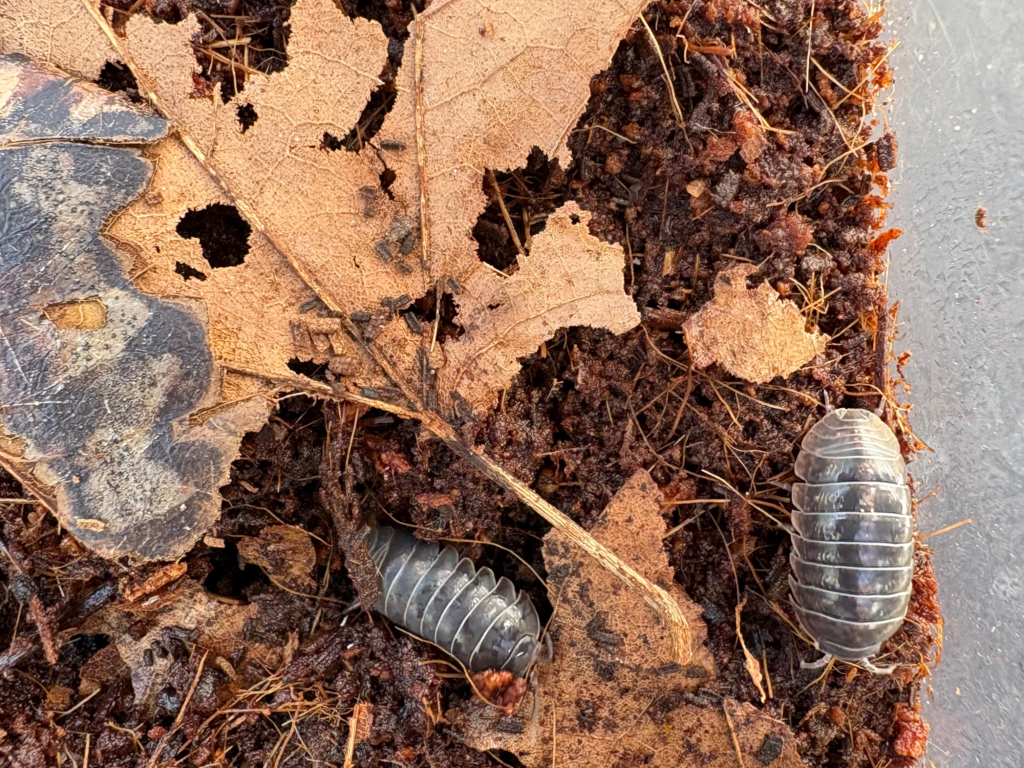
Feeding Is Not the Main Job of the Keeper
In a healthy bioactive enclosure, feeding is secondary.
Most beginners overfeed because they assume isopods and springtails need constant input. In reality, the enclosure itself should provide most of what they need.
When feeding becomes the main activity, it’s usually a sign the system isn’t doing its job yet.
The goal of feeding is support, not dependence.
What the Cleanup Crew Actually Eats
Isopods and springtails don’t eat waste directly.
They eat what waste becomes.
Their primary food sources are:
- Decaying leaf litter
- Microbial growth in the substrate
- Softening wood and organic matter
Supplemental food exists to:
- Support growth
- Prevent nutrient deficiencies
- Boost populations once the system is stable
If leaf litter is missing or thin, no amount of “food” fixes the problem.
The Base Diet (Always Available)
This should never run out.
Leaf Litter
Leaf litter is the foundation of feeding.
It provides:
- Constant food
- Shelter
- Moisture retention
- Breeding zones
As it breaks down, it’s replaced — slowly and deliberately.
If you only feed one thing, this is it.
Calcium (Non-Negotiable)
Calcium is essential for:
- Exoskeleton health
- Successful molts
- Long-term colony stability
Without it, colonies may survive for a while and then suddenly collapse.
Calcium should be:
- Available at all times
- Dry
- Not buried
This allows isopods to self-regulate intake.
You don’t need to manage doses.
You just need to make it accessible.
Supplemental Foods (Use Sparingly)
Supplemental food is not a daily activity.
It’s used to:
- Support growing colonies
- Add protein occasionally
- Encourage reproduction when conditions are right
Good supplemental options include:
- Specialized isopod or invertebrate diets
- Dried vegetable matter
- Small portions of soft food that break down quickly
Place food:
- On top of leaf litter
- Under cork
- In shallow areas where it can be removed if uneaten
If food remains after 24–48 hours, you added too much.
Protein: When Less Is More
Protein drives growth — and problems.
Too much protein causes:
- Explosive mold
- Mite outbreaks
- Strong smells
- Population crashes
For beginners:
- Protein should be occasional
- Small portions only
- Removed if uneaten
In many stable enclosures, protein supplementation isn’t needed at all for long periods.
Feeding Springtails (Almost Invisible)
Springtails rarely need direct feeding.
They thrive on:
- Microbial growth
- Mold
- Fine organic debris
If springtails are present and the substrate stays moist, they regulate themselves.
Overfeeding for springtails usually creates more problems than benefits.
How Often to Feed (Simple Rule)
A good baseline:
- Leaf litter: continuous
- Calcium: always available
- Supplemental food: once every 1–2 weeks
- Protein: occasionally, not routinely
If you’re feeding more often than this, step back and reassess the system.
Bioactive setups reward restraint.
Signs You’re Feeding Correctly
Things are working when:
- Food disappears gradually, not instantly
- Leaf litter breaks down over time
- Populations grow slowly and steadily
- There are no strong odors
- Mold appears briefly, then fades
Perfectly clean enclosures are usually unstable.
Signs You’re Overfeeding
Slow down if you see:
- Food piling up
- Persistent fuzzy mold
- Large numbers of isopods on the surface
- Strong smells
- Sudden population spikes followed by drops
Feeding should support the system — not overwhelm it.
The Long View
A bioactive enclosure is not a feeding schedule.
It’s a loop:
- Organic matter breaks down
- Cleanup crew processes it
- Nutrients return to the substrate
- The system stabilizes
Your job is not to “keep it alive.”
Your job is to not interfere once it’s working.
Long-term success depends less on feeding and more on what you don’t disturb.
Where to Go Next
Once feeding feels boring and predictable, you’re doing it right.
From here, these pages make sense:
- Maintaining a Healthy Bioactive Enclosure (Long Term)
- Isopod Starter Kits: When They’re Worth It
- Common Bioactive Mistakes (And How to Avoid Them)
The quieter the system becomes, the more successful it is.
Occasional Supplements
These are used occasionally to support a stable bioactive system.
- Leaf litter (refreshed over time)
- A calcium source
- A small amount of invertebrate food