A practical build order that avoids the mistakes most beginners make.
What This Guide Is (and Isn’t)
This is not a showcase build.
It’s not a “perfect” enclosure.
And it’s not designed to look impressive on day one.
This guide exists for one reason:
To help you build a stable bioactive enclosure that actually works, even if it’s your first one.
If you follow this order, you don’t need experience.
You don’t need special tools.
You don’t need to fix things later.
Before You Start: One Rule That Matters
Do not add animals until the environment is ready.
Most failed setups don’t fail because of the species chosen.
They fail because the system was rushed and populated too early.
This guide builds the enclosure first, then life.
Step 1: Choose a Container That Can Breathe
You don’t need a glass terrarium to succeed.
You need a container that can hold moisture and exchange air.
Good options:
- Small glass terrariums with ventilation
- Plastic tubs with mesh or vented lids
Avoid:
- Fully sealed containers
- Containers with no airflow at the top
The size doesn’t matter nearly as much as beginners think.
Stability matters more than space.
Step 2: Add the Substrate (and Get It Right)
Substrate goes in first, and it sets the tone for the entire system.
What you’re aiming for:
- Moist, not muddy
- Compressible, not loose
- Deep enough to buffer moisture
For small enclosures, you do not need elaborate drainage layers.
A single, well-hydrated substrate layer works fine.
Before moving on:
- Mix the substrate evenly
- Lightly compress it
- Mist it so it’s damp throughout, not just on top
If you squeeze a handful and water pours out, it’s too wet.
If it falls apart dry, it’s too dry.
Step 3: Create Structure Before Adding Life
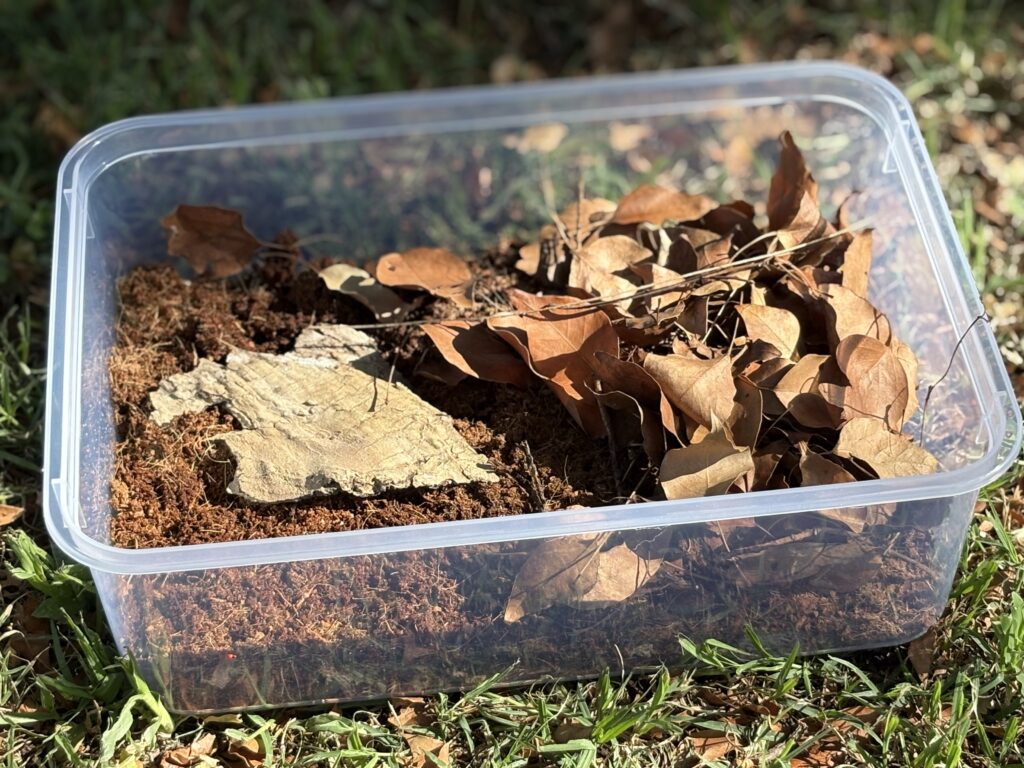
Structure comes before leaf litter and animals.
Place your hardscape directly onto the substrate:
- Cork bark flats
- Cork rounds
- Wood pieces that won’t rot quickly
Push them slightly into the substrate so they don’t shift.
You’re creating:
- Contact points
- Dark zones
- Sheltered pockets
If everything sits on top, nothing feels safe underneath.
At this stage, the enclosure should already look “occupied,” even without animals.
Step 4: Add Leaf Litter Generously
This is where many beginners underdo it.
Leaf litter should:
- Cover most of the substrate
- Be layered, not scattered
- Touch the cork and walls in places
This layer becomes:
- Primary food
- Moisture buffer
- Shelter
- Breeding ground
If you can easily see large areas of bare substrate, add more.
Leaf litter is not messy.
It’s functional.
Step 5: Set the Moisture Balance
Before adding anything alive, stabilize moisture.
Mist the enclosure until:
- The substrate is evenly damp
- The leaf litter is slightly moist
- The lower layers hold humidity
Then stop.
Close the lid and leave it alone for several hours.
You’re checking for:
- Condensation buildup (too wet)
- Rapid drying (too dry)
- Stagnant, swampy smell (no airflow)
Adjust ventilation or misting now, not later.
Step 6: Let the Enclosure Sit
This step feels unnecessary — and it’s why many setups fail.
Let the enclosure sit for 24–72 hours.
This allows:
- Moisture to distribute evenly
- Microbial activity to begin
- Temperature to stabilize
During this time:
- Do nothing
- Don’t add food
- Don’t add animals
If mold appears lightly, that’s normal.
It’s exactly why cleanup crews exist.
Step 7: Add the Cleanup Crew
Once the environment is stable, add life.
Start with:
- Springtails
- Then isopods
Introduce them gently and spread them across:
- Leaf litter
- Under cork
- Along moist zones
Do not dig them in.
Let them find their own spaces.
If the environment is right, they disappear quickly — that’s a good sign.
If you’re unsure which species to start with, begin with hardy isopods.
Step 8: Minimal Feeding (at First)
In a fresh setup, less is more.
Early on:
- Leaf litter does most of the feeding
- Supplemental food should be minimal
Overfeeding causes:
- Mold explosions
- Smell
- Population crashes
Add calcium sources early, but sparingly.
The system will regulate itself if you don’t interfere.
Step 9: Hands Off
Once stocked, the enclosure needs time, not attention.
For the first few weeks:
- Light misting only when needed
- No cleaning
- No rearranging
- No constant feeding
A stable bioactive tank looks quiet at first.
That doesn’t mean it’s failing.
It means it’s settling.
What a Healthy Setup Looks Like
Signs things are working:
- Condensation cycles, not constant fog
- Isopods visible mostly at night or under cover
- Leaf litter slowly breaking down
- No strong smells
If you see these signs, stop adjusting.
Bioactive systems reward patience, not intervention.
Where to Go Next
Once your enclosure is built and stable, these next steps make sense:
- Best Isopods for Beginners (Hardy & Forgiving)
- Feeding Isopods & Cleanup Crews (What Actually Works)
- Isopod Starter Kits: When They’re Worth It
The setup always comes first.
Everything else builds on it.
Basic Setup Items
These are the basic items used to build a simple bioactive enclosure.
- A ventilated container or small terrarium
- Coco fiber or bioactive substrate
- Leaf litter
- Cork bark (for structure and hides)